Institutional
Real Estate
East Africa
Mandate-based advisory for institutional investors seeking structured exposure to East African commercial assets.
Qualified Purchasers · Min. $5,000,000
$1.2B+
Assets Under Advisory
8.5–12.5%
Target Yield Range
2+
Years Active in Market
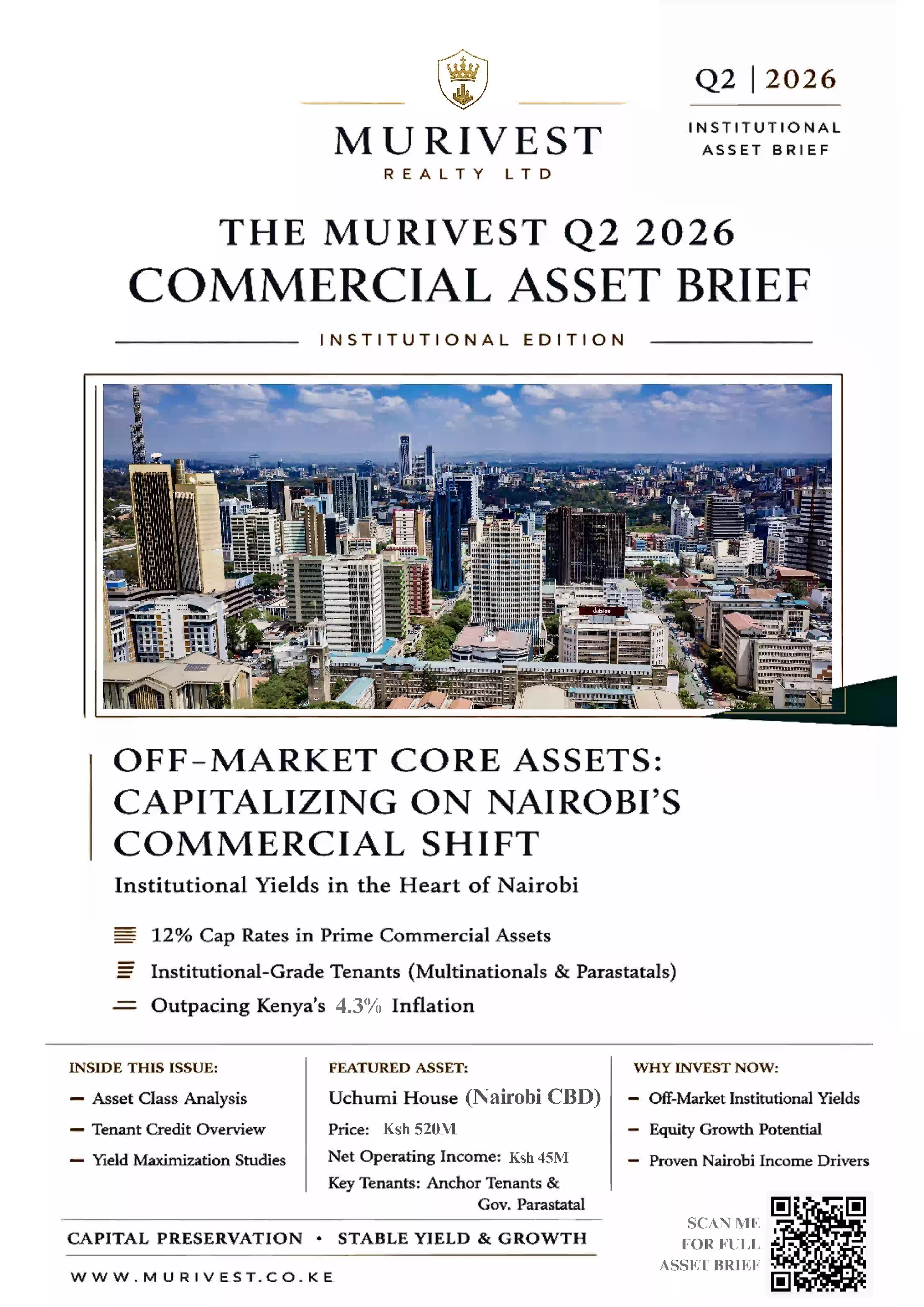
Nairobi Commercial Asset Brief
Institutional-grade overview of Nairobi commercial real estate opportunities, valuations, and capital positioning.
Verified investors only
Commercial Real Estate
Strategic Exposure
Murivest Realty Group advises across selected commercial real estate sectors aligned with urbanisation, infrastructure expansion, and institutional demand trends.


Income-Oriented Commercial Assets
Core Office Strategy
Institutional-grade office exposure supported by multinational tenancy demand and constrained Grade A supply dynamics.
Retail · Office Integration
Urban Mixed-Use Platforms
Diversified mixed-use positioning across high-density urban corridors with defensive occupancy characteristics.
Trade & Infrastructure Exposure
Logistics & Industrial Corridors
Industrial and logistics positioning aligned with East Africa’s evolving regional trade infrastructure.

Residential · Urban Living
Multi-Family Residential
Strategic positioning in multi-family residential assets to get consistent cashflows at the right location and refinance with increased rental rates and gain from capital appreciation.
Engagements conducted under formal advisory mandate and applicable regulatory compliance procedures.
Request Advisory EngagementInvestment System
Core Investment
Strategies
Murivest structures disciplined, mandate-based real estate strategies across three commercial asset classes — each selected for income durability, institutional governance, and risk-adjusted return profiles across East African cycles.
Core Office Market
Grade A Office Assets
Institutional-grade office buildings anchored by long-duration tenants across Nairobis prime commercial nodes — Westlands, Gigiri, and Karen. Focus on occupancy resilience and capital preservation through market cycles.
High-Yield Hospitality
Hospitality & Hotel Assets
Selective hospitality mandates in high-demand urban and tourism corridors. Underwriting prioritises RevPAR stability, operator covenant strength, and repositioning upside in supply-constrained markets.
Defensive Retail
Retail & Mixed-Use Hubs
Destination retail and integrated mixed-use centres anchored by essential-service tenants with strong catchment fundamentals. Positioned for income durability and structural demand from Kenya's expanding urban consumer base.
Core Office Market
Grade A Office Assets
Institutional-grade office buildings anchored by long-duration tenants across Nairobis prime commercial nodes — Westlands, Gigiri, and Karen. Focus on occupancy resilience and capital preservation through market cycles.
High-Yield Hospitality
Hospitality & Hotel Assets
Selective hospitality mandates in high-demand urban and tourism corridors. Underwriting prioritises RevPAR stability, operator covenant strength, and repositioning upside in supply-constrained markets.
Defensive Retail
Retail & Mixed-Use Hubs
Destination retail and integrated mixed-use centres anchored by essential-service tenants with strong catchment fundamentals. Positioned for income durability and structural demand from Kenya's expanding urban consumer base.
"The best investment on Earth is earth — structured, mandated, and protected."
View Full PortfolioInstitutional Standards
Exit Strategy &
Risk Engineering
In Kenyan commercial real estate, losses rarely come from market cycles — they come from structural failures: title defects, poor exit planning, and regulatory exposure. Murivest structures the exit before acquisition, ensuring every asset is engineered for controlled liquidity and capital protection.
7 – 10
Year Hold Horizon
Exit Is Designed at Entry
Institutional capital globally now holds assets for 6–7 years on average. Murivest pre-defines exit timing, buyer profile, and disposal pathway at mandate inception so every lease and capital decision aligns with exit value creation.
McKinsey Global Private Markets Report 2026
40%
of Land Fraud Cases in Kenya
Title Risk Is Structural
Land-related fraud remains the dominant form of financial loss in Kenya’s property market, with over 10,000 active investigations. Every mandate begins with forensic title verification, encumbrance checks, and regulatory compliance screening.
EACC 2023 · Ministry of Lands Kenya 2024
3
Exit Structures
Liquidity Is Engineered
Exit is structured through institutional sale, recapitalisation, or sale-leaseback mechanisms depending on asset profile. Each route is designed for tax efficiency, compliance alignment, and capital mobility under IFRS standards.
McKinsey GPM 2025 · IFRS 16 · KRA CGT Framework
“Capital without structured exit design is exposure, not investment.”
Request Exit BriefMarket Intelligence · Q2 2026
Nairobi Commercial
Real Estate Intelligence
Nairobi's commercial market is undergoing structural rebalancing. Capital is concentrating in Grade A office, logistics, and mixed-use corridors, while secondary stock continues to dilute pricing power and occupancy across the metro area.
Grade A Office
Westlands · Gigiri · Karen
Compressing
Westlands leads absorption — flight-to-quality demand accelerating
Industrial & Logistics
Nairobi · Tatu City · JKIA Zone
Tightening
Structural demand expansion from e-commerce and agro-logistics
Retail — Destination Centres
Kilimani · Westlands · Karen
Stable
Selective node strength — anchor-tenant covenants remain resilient
Mixed-Use Development
Integrated Assets
Outperforming
Highest blended yield — diversified income structure
Grade A Office
Westlands · Gigiri · Karen
Yield
8.5%
Vacancy
19.3%
Signal
Compressing
Westlands leads absorption — flight-to-quality demand accelerating
Industrial & Logistics
Nairobi · Tatu City · JKIA Zone
Yield
9.5%
Vacancy
17.0%
Signal
Tightening
Structural demand expansion from e-commerce and agro-logistics
Retail — Destination Centres
Kilimani · Westlands · Karen
Yield
8.4%
Vacancy
19.8%
Signal
Stable
Selective node strength — anchor-tenant covenants remain resilient
Mixed-Use Development
Integrated Assets
Yield
8.4%
Vacancy
~18.5%
Signal
Outperforming
Highest blended yield — diversified income structure
Grade A assets continue to outperform across Westlands, Gigiri, and Karen, driven by tenant consolidation and flight-to-quality dynamics. Industrial logistics remains the strongest structural allocation theme in Kenya, supported by sustained regional distribution and e-commerce demand.
Mandated intelligence only · KYC required · Q2 2026
Request Full Intelligence PackInvestment Framework
Five Principles
One Objective
Capital in this market is rotating faster than at any point in the last decade. The question is not whether it moves — but whether it moves into structure or exposure.
Income That Endures. Not Appreciation That Disappears.
Capital is rotating away from lifestyle property into income-producing commercial assets. Knight Frank confirms a structural reallocation: primary residence exposure collapsed in a single year. The implication is simple — capital that does not enter structured income assets is left exposed to informal mid-market risk and construction-sector stress.
Knight Frank Wealth Report 2025
Market Philosophy
22%
HNWI wealth in primary homes
↓ from 50–60% (2024)
Income That Endures. Not Appreciation That Disappears.
Capital is rotating away from lifestyle property into income-producing commercial assets. Knight Frank confirms a structural reallocation: primary residence exposure collapsed in a single year. The implication is simple — capital that does not enter structured income assets is left exposed to informal mid-market risk and construction-sector stress.
Knight Frank Wealth Report 2025
Where the Data Points Before the Market Arrives.
Industrial real estate is the strongest structural signal in the market. Occupancy across Africa reached a decade high, driven by e-commerce and agro-logistics demand. In Nairobi, Grade A logistics assets continue to show yield premium and supply constraints relative to demand.
Knight Frank Africa Industrial H1 2025
Asset Selection
9.5%
Prime logistics yield — Nairobi
83% Africa warehouse occupancy
Where the Data Points Before the Market Arrives.
Industrial real estate is the strongest structural signal in the market. Occupancy across Africa reached a decade high, driven by e-commerce and agro-logistics demand. In Nairobi, Grade A logistics assets continue to show yield premium and supply constraints relative to demand.
Knight Frank Africa Industrial H1 2025
Downside Protection Is the Strategy.
Every acquisition is stress-tested beyond current market conditions, including vacancy expansion and rent compression scenarios. Capital preservation is not assumed — it is engineered. This discipline reflects broader private market reality where operational resilience now drives returns more than leverage.
Murivest Underwriting Framework
Risk Discipline
5–8pp
Vacancy stress test buffer
Murivest underwriting standard
Downside Protection Is the Strategy.
Every acquisition is stress-tested beyond current market conditions, including vacancy expansion and rent compression scenarios. Capital preservation is not assumed — it is engineered. This discipline reflects broader private market reality where operational resilience now drives returns more than leverage.
Murivest Underwriting Framework
Leverage Amplifies Returns — and Risk.
Global commercial real estate stress highlights the cost of aggressive leverage cycles. Underwater loan exposure in major markets reinforces a structural shift: debt must be sized to income resilience under stress, not optimistic pricing cycles.
MSCI Real Estate in Focus 2025
Capital Structure
14%
US CRE loans underwater (2025)
~$500B exposed globally
Leverage Amplifies Returns — and Risk.
Global commercial real estate stress highlights the cost of aggressive leverage cycles. Underwater loan exposure in major markets reinforces a structural shift: debt must be sized to income resilience under stress, not optimistic pricing cycles.
MSCI Real Estate in Focus 2025
UHNW Capital Requires Infrastructure.
UHNW capital behaves differently — it requires access, structuring, and governance. Institutional managers increasingly compete on access to private capital networks, not just deal flow. Murivest operates within that framework: off-market access, structured entry, defined exit.
Knight Frank / McKinsey Wealth Data
Investor Access
0.003%
Global population (UHNWIs)
Control > 1/3 global private wealth
UHNW Capital Requires Infrastructure.
UHNW capital behaves differently — it requires access, structuring, and governance. Institutional managers increasingly compete on access to private capital networks, not just deal flow. Murivest operates within that framework: off-market access, structured entry, defined exit.
Knight Frank / McKinsey Wealth Data
This framework is applied only to mandated capital relationships. Every allocation is reviewed against downside protection, exit clarity, and structural resilience before execution.
Request AccessEnvironmental · Social · Governance
ESG Framework
Capital Risk Lens
ESG at Murivest is not a reporting function — it is a capital protection filter. It determines what is investable, what is bankable, and what is institutionally acceptable before capital is deployed into East African real estate markets.
100%
ESG-Screened Mandates
3+
Framework Benchmarks
GRI / IFRS
Reporting Standards
Environmental
Responsible Investment Integration
Environmental, social, and governance considerations are embedded directly into underwriting rather than treated as post-investment reporting. Each mandate is screened through a risk-adjusted lens consistent with institutional capital expectations, including PRI-aligned frameworks where applicable.
Social
Built Asset Sustainability Standards
Asset selection prioritises measurable efficiency in energy use, water consumption, and embodied carbon. Where applicable, developments are assessed against IFC EDGE and LEED frameworks, with emphasis on climate resilience and long-term operating cost stability.
Governance
Institutional Governance & Reporting
Each mandate is structured with formal governance controls, legal compliance verification, and reporting frameworks aligned with institutional investor requirements. ESG and financial performance are tracked in parallel where required for fiduciary reporting obligations.
Long-duration capital requires long-duration stewardship. ESG is not an overlay — it is structure.
View Full ESG FrameworkExecutive Leadership

Mark Muriithi
Chief Executive Officer · Founder
“Institutional capital is not deployed for momentum — it is allocated for durability. Downside protection precedes structure. Structure precedes return.”
Mark Muriithi founded Murivest Realty Group in 2025 to bridge institutional capital and Kenya’s commercial real estate market through structured advisory, disciplined underwriting, and off-market execution.
His background spans commercial real estate, distribution, and technology — experience that informs Murivest’s approach to deal origination, asset positioning, and investor execution. Earlier roles at Vineyard Properties provided direct exposure to transactional real estate markets, while subsequent commercial leadership roles strengthened capital markets literacy and network depth across East Africa.
Murivest is structured to align with institutional expectations: underwriting discipline, governance transparency, ESG awareness, and reporting standards consistent with pension funds and family offices.
Independent Advisory Platform
Mandate-based engagements · Institutional underwriting standards · Fiduciary alignment
API Global
United Kingdom · Est. 2004
Baron & Cabot
United Kingdom · Est. 2014
Knight Frank
Kenya · Est. 1896
Pam Golding
Kenya · Est. 1976
Black Standard — Private lifestyle infrastructure partner providing UHNW mobility coordination, aviation access, concierge services, security orchestration, and global residence logistics through a discreet, invitation-based network.
Non-public access layer · Discretion-first execution · Invitation-only coordination
Visit Strategic PartnerRegulatory Framework & Disclosures
Mandate Documentation Required
All engagements governed by formal mandate agreements defining scope, liability, and execution terms prior to advisory commencement.
KYC / AML Compliance
Full identity and source-of-funds verification required for all capital partners prior to any advisory or transaction engagement.
No Collective Investment Schemes
Murivest does not pool capital or operate regulated investment funds. Strictly advisory services on a mandate basis only.
Murivest Realty Group Ltd is an independent commercial real estate advisory platform. All engagements are subject to formal mandate agreements, independent due diligence, and regulatory compliance frameworks applicable in Kenya and international jurisdictions.